Why You Need
Cash Flow Updates
The most common reason businesses fail is a cash flow crisis
Cash Flow Updates is a tool that shows you when you can expect a shortfall in your cash flow weeks before it hits, so you have time to take the necessary steps to prevent it.
Businesses that fail run out of cash at the wrong moment, with no warning. In one widely cited U.S. Bank study a cash shortage is the reason that 82% of small businesses fail.
But a cash shortage is one of the few business problems you can predict long before it arrives, if you are using the right cash flow forecasting tool.
Cash shortages don't happen overnight - They are predictable
A cash crunch builds over weeks. The warning signs are already in your numbers:
- A slow month
- A big expense landing before a large receivable
- A season that always runs tight
The problem isn’t that these moments are unpredictable. It’s that you need to look far enough ahead to identify the problems that are coming.
With Cash Flow Updates you can map out your revenue and expenses week by week, so a shortfall three months away shows up on your screen today, while there’s still time to change the numbers or prepare for them before they occur. You can test your options: bring in revenue sooner, push back an expense, or arrange financing early, when the terms are still in your favor. You can also see which moves work best to close the gap before you commit to any of them.

What happens when you can see problems weeks in advance
In January, your forecast shows a $20,000 shortfall coming in March. You have over two months to respond: collect from slow paying customers, run a promotion, trim a planned expense, or line up a short term credit line. The shortfall never becomes a crisis, because you spotted it early.
Now picture the same business without a forecast. March arrives, the account runs dry, and the scramble begins: calling the bank from a position of weakness, delaying payroll, taking whatever terms you can get. The numbers were identical. The only thing that changed was how far ahead you could see them.
Seeing the shortfall in January instead of March is the difference between bookkeeping and cash flow planning: one tells you what already happened, the other tells you what to do next.
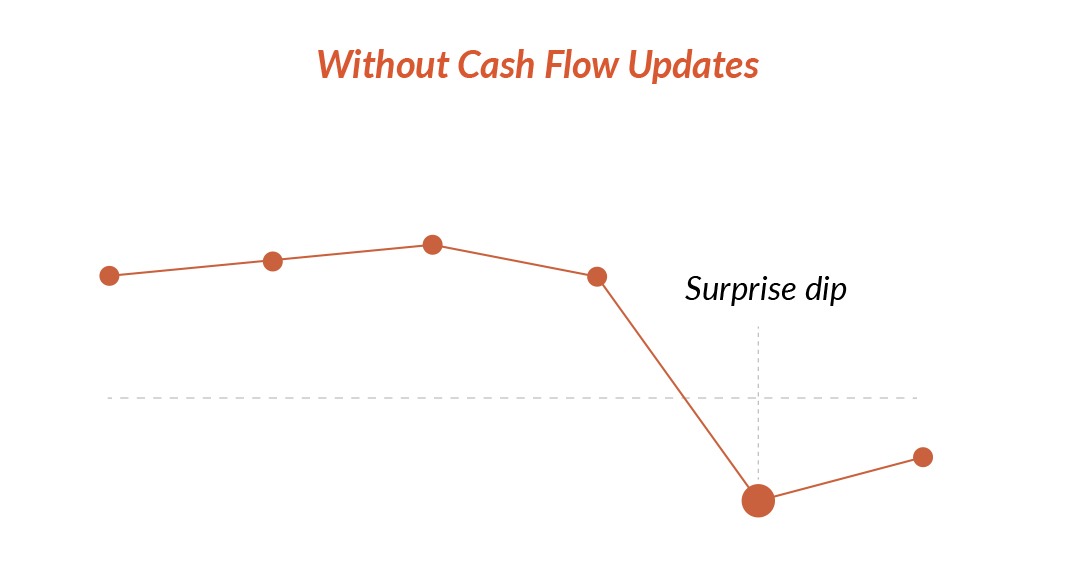
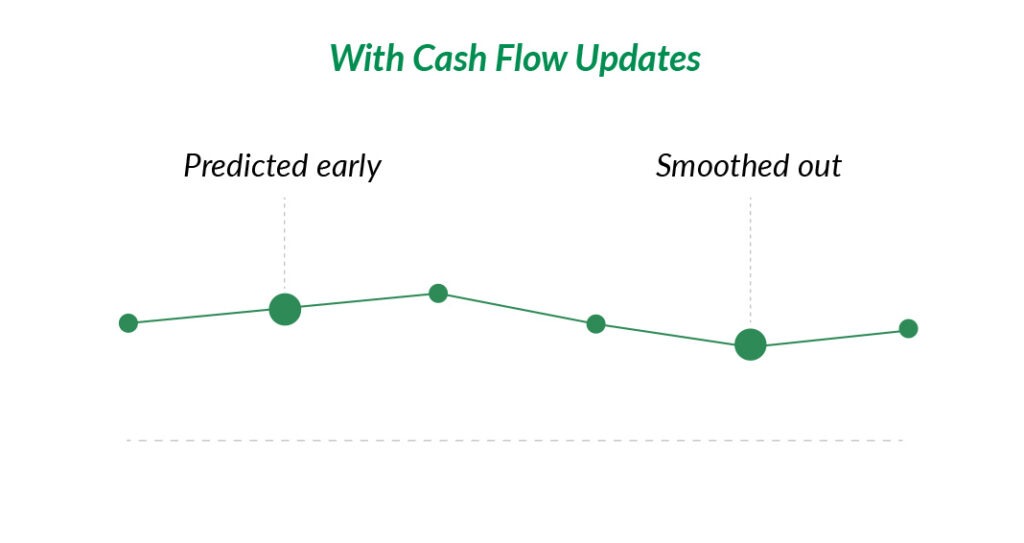
No more surprises
Know when a cash shortage is coming, and act while you still have options. Cash Flow Updates is easy to set up, simple to use, and gives you the information you need to make the best decisions.
Cash Flow Updates gives you the tool to track your future needs easily
The cash flow of your business is simply the movement of money in and out of your business. Your revenues are the money in, and your expenses are the money that goes out. To maintain a successful business, you need to know in advance when you may have cash shortfalls, so you can plan ahead and assure the long term success of your business.
With effective cash flow management you know when a cash shortfall could occur and how much it will be, so you can make arrangements to have the cash you need to keep your business operating efficiently and avoid a crisis. The most common reason that businesses fail is a cash flow crisis. You can avoid this type of crisis simply by using Cash Flow Updates to track and project your income and expenses, so that you understand exactly what your cash flow position is and when there could be a problem in the future.
Identifying when a cash shortage will occur is key
There are many reasons why you could face a cash shortage, but if you map out the expectations every week for your revenues, you will see the immediate long term impact of a shortfall when you use Cash Flow Updates. Every week you will replace the projected revenues and expenses with the actual revenues and expenses. Then, you will see how any changes will affect the coming weeks.
Enter the expectations for each week, both revenues and expenses. You’ll see when you run into a cash shortage and what your options are to increase revenue and reduce expenses. You can enter what you think you can do, and you will see how those changes impact the future cash flow right away.
You’ll see exactly when there could be a problem, so you can act now to impact the numbers.
Each week, you’ll confirm the numbers, adjust any discrepancies, and see how the changes affect the weeks to come.